| ENGINE TYPE | Liquid-cooled, two-stroke, single cylinder |
| Displacement | 124 cm3 |
| Bore X Stroke | 2.12x2.12 in OR 54 mm X 54.5mm |
| Compression | 15.1:1 |
| Cooling System | Liquid Cooled |
| Induction | 28mm DellOrto carburetor |
| Max Power | 28/10500 KW(hp)/RPM |
| Max Torque | 13/10000 lb-ft/RPM OR 18/10000 Nm/RPM |
| TRANSMISSION SPECS | |
| Gear Box | 6-speed, manual |
| Clutch | Wet multi-disc, manual |
| Primary Drive | Gear |
| Final Drive | Chain |
| CHASSIS SPECS | |
| Frame | Steel |
| Front Suspension | 38mm upside-down fork |
| Rear Suspension | Adjustable monoshock with APS |
| Front Brakes | Single 320mm disc, 4-piston caliper |
| Rear Brakes | Single 240mm disc, 2-piston caliper |
| DIMENSION SPECS | |
| Overall Length | — |
| Seat Height | 31.5 in OR 800 mm |
| Weight | 131 Kgs / 289 lbs |
| TYRES SPECS | |
| Front Tyre | 100/80-17 inch |
| Rear Tyre | 130/70-17 inch |
| FUEL SYSTEM | |
| Fuel System | 28mm DellOrto carburetor |
| Fuel Capacity | 5.3 gallons OR 20.1 L |
| Fuel Consumption | 4.1 L / 100kms or 24.4km /L |
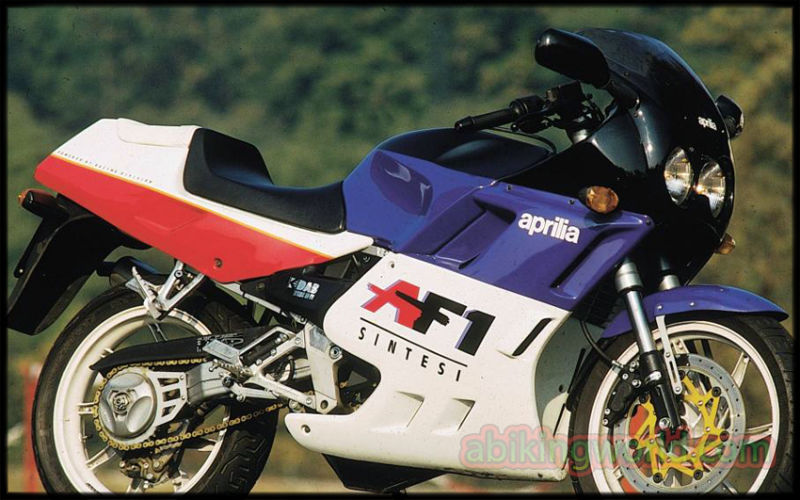


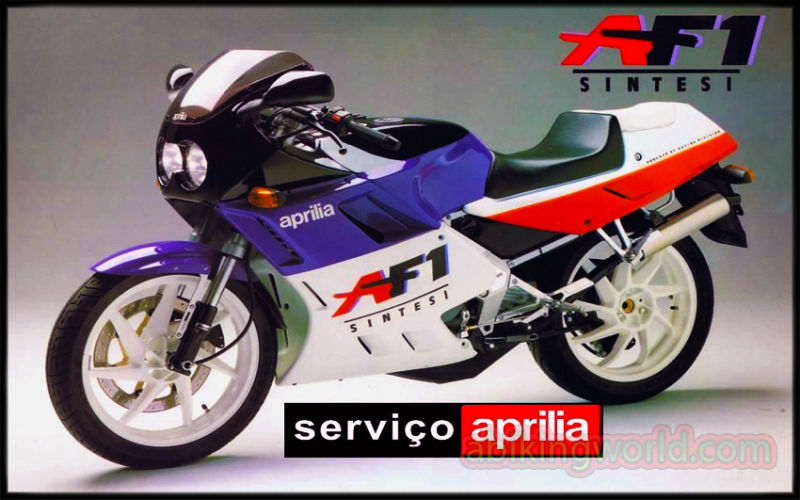
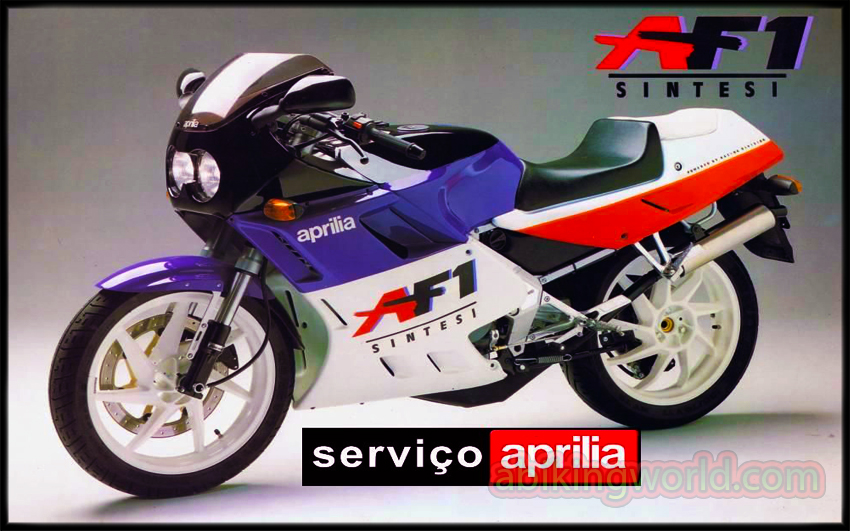
Presented on June 8, 1988 in Sardinia and marketed immediately afterwards, the AF1 Sintesi '88, type EH, is perhaps the road 125 that more than others contains so many technical innovations in a single package. 1988 is a fundamental year for the Italian houses engaged in the production of eighth of a liter: never as in that year we see new items such as to make the models presented only a year before totally obsolete. Cagiva stands out from the group by presenting the Freccia C10R which is only an update of the valid C9, but Gilera and Honda respectively present the unpublished MX1 and NSR-F which are a huge step forward compared to previous models. Aprilia with the AF1 Sintesi, however, stands a step above the competition: line inspired by the splendid Honda RC 30, double beam aluminum frame, 38mm upside-down fork, single-sided swingarm and APS suspension, 17 ”wheels, disc brake 320 mm floating front with four-piston caliper and brand new Rotax 123 engine equipped with RAVE 2 exhaust valve, they are the calling card of the new 125 road car from the house of Noale. The Sintesi is undoubtedly one of the most technological motorcycles of 1988, far ahead even with respect to many noble Japanese maxi. The price in 1988 is Lire 5,391,000 and the colors are Black / Purple / White with White / Red and Blue / Aquamarine / White codon always with White / Red codon. For foreign markets, a third Reggiani Replica color is then prepared, characterized by the number "6" on the tail section. This coloring is marketed in Italy with the subsequent AF1 Sintesi '89, characterized however by the number “4” on the tables in deference to the Belgian pilot De Radigues. (see related article). La Sintesi successfully participates in the Italian Sport Production '88 championship where, although registered in the late season, it obtains excellent placings and victories which at the end of the season are worth third place with the official Aprilia test driver Claudio Pellizzon. As per Aprilia tradition, the Sintesi remains in production for just over a year to be soon updated by the '89 model which will also sport a beautiful Replica color and a Sport version dedicated to Sport Production races. The model identification code for Sintesi '88 is EH and is followed by DGM 52503 and chassis numbering starting with o300 ****. The bike in brief The AF1 Sintesi was defined, not wrongly, the small replica of the splendid and exclusive Honda RC30 and, in fact, the similarity is so great: the double analog headlight, the single-sided swingarm with cantilever wheel, the generous braking system, the technopolymer fairing perfected in the wind tunnel and the rear seat in the same color as the seat that seems to be a single-seater, are all decidedly racing elements and elegantly inspired by the RC30. The quality of the plastics and the level of finish is generally excellent and there are several valid components present on the previous AF1 which are maintained, such as the beautiful and complete instrumentation produced in Japan and the CEV electric controls therefore remain the same as those mounted on the Project 108. Improved instead, the rear view mirrors that are now more pleasing and with a more modern design. To facilitate maintenance operations, the tank can now be tipped (after unscrewing a special Allen key) and can be kept in an elevated position, thanks to a dipstick. Once opened, the tank gives access to the battery (now located in a position close to the steering tube between the frame beams), to the expansion tank of the cooling system and obviously to the spark plug. Lifting the pilot seat, protected by a lock, you can access the tool-holder compartment and the mixer oil tank. The air filter case is always on the right side as on the Project 108 and is easily accessible. With regard to the tank, it is interesting to note that the specimens produced in the first two / three months are characterized by the modification indices "A" and "B" (visible on a label on the seat post frame) have the tank cap on the right side and are free the external vent on the opposite side (the vent was only the one in the tank cap); the modification indices "A" and "B" concern only the AF1 125 Synthesis of the first color. With the entry into production of the AF1 125 Sintesi with modification code "C", the assembly of the tanks began with the cap on the left side and the external vent on the right side: this model was produced both in first and second colors for throughout 1988. Chassis The chassis represents a very advanced evolution compared to the AF1 Project 108: the beautiful frame with double diagonal beam in extruded aluminum is decidedly stiffer and lighter than the old frame of the AF1 Project 108. The 38 mm upside-down front fork is entirely new and remains non-adjustable: its presence has led to the change of the plates, always of elegant design and equipped with a protuberance for the ignition lock. The single-sided swingarm in sheet steel box and the valid progressive rear suspension (always Sebac not adjustable) APS, adjustments aside, remain the same seen on the Project 108. The braking system now adopts a brand new and splendid 320 mm floating disc at the front (the first of the 125cc cases) and equipped with a four-piston caliper of differentiated diameter; at the rear there is the valid 240mm disc served by the double piston caliper of the previous AF1. The beautiful new 17 ”wheels house the valid Pirelli MT 79 tires respectively in the sizes: 100 / 80-17 front and 130 / 70-17 rear. The dry weight drops to 131 kg, compared to 134 kg detected on the Project 108. Engine The new Rotax 123 replaces its predecessor 127 and lends itself to be an extremely long-lasting engine, being in fact used, with the necessary continuous updates, on all the Aprilia 125 road and enduro range up to and including 1994, when it will be replaced by the 122. Here are the most important changes introduced: New aluminum cylinder with Gilnisil treated barrel (cylinder code 223362). New two-piece head to improve cooling. Stroke increased by 0.5mm (dimensions 54 × 54.5 instead of 54 × 54 on the Rotax 127). Compression ratio dropped to 15: 1 (15.5: 1 on Replica). Balancing countershaft (absent on Rotax 127). Carburetor Dell'Orto PHBH 28 RD with oval section. New Air Box equipped with dynamic air intake mounted on the right side of the motorcycle. Slightly longer primary transmission, with two last gears and shorter final ratios to take better advantage of extended qualities. In the face of the changes made, the Sintesi engine detects a maximum wheel power of 28.66 hp at 10500 rpm: a slight deterioration in terms of absolute power compared to the Rotax 127 mounted on the Project 108 Replica (29.24 hp at 10250 rpm), but to the full advantage of the delivery now decidedly more full-bodied at low and medium revs and therefore more exploitable, also thanks to the revised ratios. The Synthesis shows exceptional shooting qualities: in the shooting tests on the 400 meters of 50 km / h, the time was 19.352 seconds and with an output speed of 96.26 km / h instead of the 21.115 seconds and 82.80 km / h measured on the previous AF1. Top speed also improves: 163.9 km / h instead of the 160.5 km / h measured on the P108 Replica.