| MODEL | BMW K1600B BAGGER |
| ENGINE TYPE | Four stroke, transverse six cylinder, 4 valves per cylinder |
| Year | 2019 / 2020 / |
| Displacement / Capacity | 1649 cc / 100.6 cu in. |
| Bore X Stroke | 72 x 67.5 mm |
| Compression Ratio | 12.2:1 |
| Cooling System | Liquid cooled |
| Max Power | 118 kW / 160.5 hp @ 7750 rpm |
| Max Torque | 175 Nm / 17.8 kgf-m / 129 lb-ft @ 5250 rpm |
| Ignition | Digital CDI |
| Induction | 52mm Throttle valve diameter, BMS-X |
| Start System | Electric |
| TRANSMISSION SPECS | |
| Lubrication | — |
| Gear Box | Constant-mesh 6-speed gearbox, helical cut |
| Clutch | Multiplate wet clutch, hydraulically activated |
| Primary / Final Drive | Final Drive : Shaft drive 2.75:1 / Primary Drive : |
| Secondary drive | — |
| Gear Ratio | 1st 2.23 / 2nd 1.641 / 3rd 1.319 / 4th 1.101 / 5th 0.926/ 6th 0.788 |
| CHASSIS SPECS | |
| Frame | Bridge-type frame, cast aluminium, load-bearing engine |
| Front Suspension | Dual longitudinal control arm, Dynamic ESA semi-active suspension (road and dynamic modes) |
| Rear Suspension | Paralever (single-sided swing arm), central spring strut, rebound/continuously variable, Dynamic ESA semi-active suspension / (road and dynamic modes) |
| Brakes | Front Brakes: 2 x 320mm discs, 4 piston calipers / / Rear Brakes : Single 320mm disc, 2 piston caliper / / ABS: BMW Motorrad ABS (partial integral) |
| Traction Management | — |
| Exhaust System | — |
| DIMENSION SPECS | |
| Overall Length | Length: 2324 m / 91.5 in |
| Seat Height | 780 mm / 30.7 in |
| Overall Height | 1465 mm / 57.7 in (excl. mirrors) |
| Overall Width | 1000 mm / 39.4 in (incl. mirrors) |
| Overall Weight | Dry Weight - / Wet Weight - 336 kg / 740.7 lbs |
| Wheelbase | 1680 mm / 66.1 in |
| Rake and Trail | Rake: / Trail: |
| WHEEL SPECS | Cast aluminium wheels |
| Wheels / Rims | Front Rim : 3.0 x 17 / Rear Rim : 6.00 x 17 / |
| Front Tyre | 120/70 ZR17 |
| Rear Tyre | 190/55 ZR17 |
| Front Wheel Travel | 115 mm / 4.9 in |
| Rear Wheel Travel | 135 mm / 5.3 in |
| Castor | 108.4 mm / 4.3 in |
| Steering Angle | 62.2° |
| FUEL SYSTEM | Premium unleaded (95 RON) |
| Fuel Capacity | 26.5 Litres / 7.0 US gal |
| Fuel Reserve | 4 Litres / 1.1 US gal |
| Fuel Consumption | — |
| CAPACITIES | |
| Engine oil | — |
| Brake fluid | — |
| Top Speed | — |

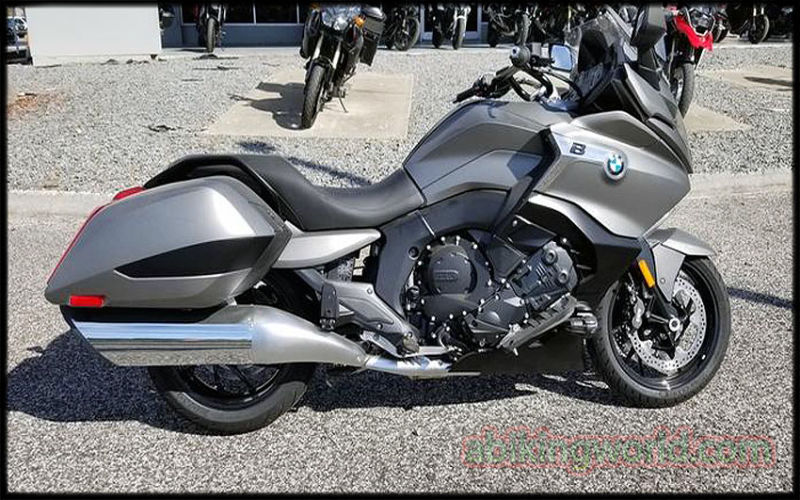

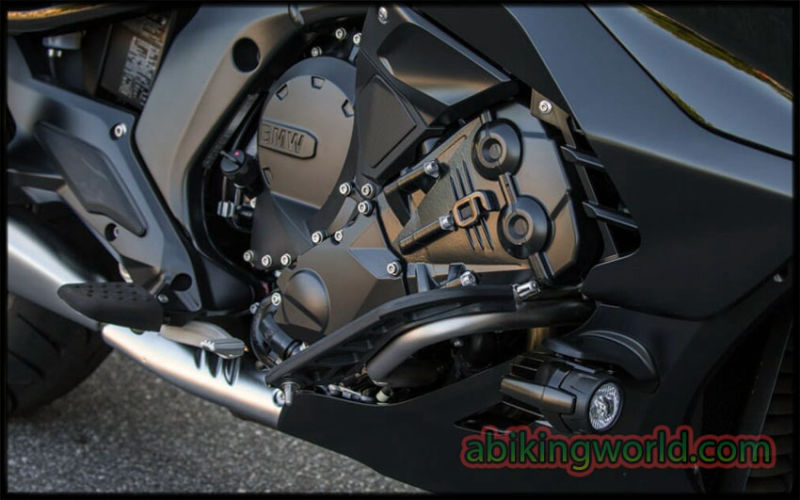
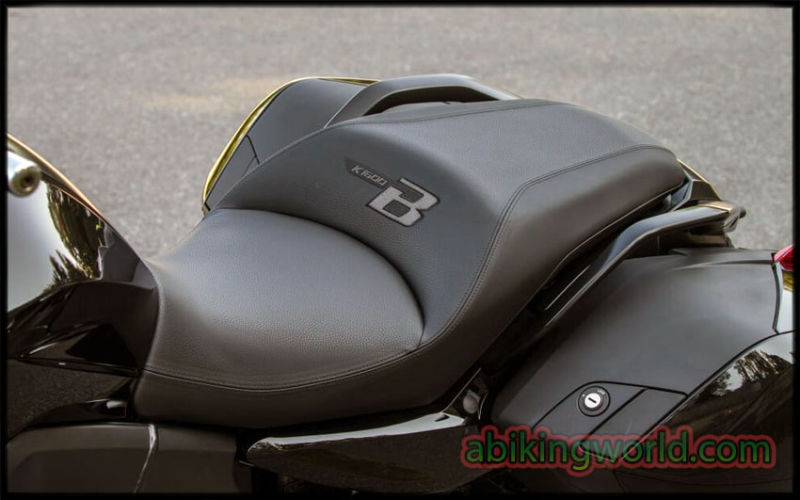

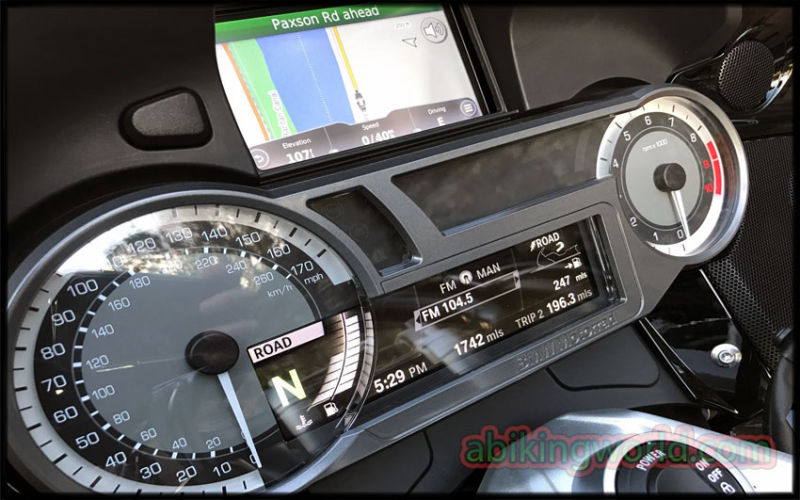

You really get to know a motorcycle when you ride it all day, every day, for an entire week. Long hours in the saddle give you plenty of time to contemplate what works and what doesn’t. After two days of riding the new BMW K 1600 B in the mountains and foothills near Asheville, North Carolina, during the press launch, I spent the next five days riding it through 14 states on my way home to California. Riding the K 1600 B from sunrise to sunset for several days in a row made its virtues and faults abundantly clear. During that weeklong, 3,500-mile odyssey, the impeccable smoothness of the K 1600 B’s perfectly balanced, turbine-like in-line six-cylinder engine was indeed a virtue. With cruise control set at the 75 to 80 mph speed limits that prevail on Interstate 70 across wide-open stretches of Kansas, Colorado and Utah, the mirrors remained crystal-clear, there was barely any vibration and the bike felt as stable—and as fast—as a bullet train. I was grateful that, with the windscreen set at just the right height, airflow around my head was smooth and quiet, the seat was all-day, day-after-day supportive and the riding position created no pain points. I also enjoyed the convenience of thumbing buttons or spinning the Multi-Controller wheel to change riding modes and suspension settings, dial up heat for the grips and seat, check tire pressure, raise or lower the windscreen and much more. And every time I toe-tapped rapid-fire, clutchless upshifts while accelerating hard out of a corner, I almost forgot I was riding a bagger. Wait—a bagger wearing the BMW roundel? That’s right. Inspired by the Concept 101, a 2015 design study by Roland Sands and BMW Motorrad, the K 1600 B is a bagger based on the K 1600 GT sport tourer that won Rider’s Motorcycle of the Year award in 2012. Alas, the Concept 101’s wooden accent panels didn’t make it into production, but much of the K 1600 B is faithful to the original. Compared to the GT, the B has a shorter windscreen, a tubular handlebar, longer, narrower saddlebags with integrated LED taillights and howitzer-like chrome mufflers that are horizontal instead of angled upward. To give the K 1600 B the appropriate bagger profile, the rear subframe and passenger seat were lowered by 2.8 inches, and a new rear fender folds up for easier removal of the rear wheel. The rider’s seat height is 30.7 inches vs. 31.9/32.7 inches on the GT, and a no-cost optional seat is just 29.5 inches. Suspension travel is also lower on the bagger, but there’s still 4.5/4.9 inches front and rear. Beneath the Black Storm metallic bodywork is the same liquid-cooled, 1,649cc in-line six-cylinder engine with DOHC, four valves per cylinder and a 12.2:1 compression ratio that powers the K 1600 GT. With a narrow 72mm bore (stroke is 67.5mm) and cylinder sleeves spaced just 5mm apart, the engine isn’t much wider than an in-line four. Perfect primary and secondary balance eliminates the need for counterbalancers and the cylinders are canted forward 55 degrees to lower the center of gravity, put more weight on the front wheel and allow the rails of the aluminum alloy bridge-type frame to pass over rather than around the engine. Even though the K 1600 platform (which includes the B, GT and GTL) has been made Euro4 compliant, BMW claims that engine output is unchanged from previous model years: 160 horsepower at 7,750 rpm and 129 lb-ft of torque at 5,250 rpm in Dynamic and Road modes, and 147 horsepower and 122 lb-ft of torque in Rain mode (measured at the crank). When we put the K 1600 B on Jett Tuning’s dyno, however, it produced lower than expected horsepower and torque at the rear wheel with irregularly shaped dyno curves, as compared to the last K 1600 GT we tested in 2013. Some motorcycles electronically limit engine output when the front wheel is immobilized but the rear wheel is spinning rapidly, as is the case during dyno runs, and such a restriction may have been incorporated into the K 1600’s engine management software. We contacted BMW Motorrad to inquire about this, but we did not receive a response before going to press. We’ll follow up in the near future. Out of the dyno room and on the road, on the other hand, the K 1600 B feels unimpeded, spinning up rapidly and sending ample power to the rear wheel through a 6-speed transmission and shaft final drive. Lots of torque is on tap even at low rpm and response from the throttle-by-wire is precise, though there’s some lag on inital throttle opening that takes some getting used to. Other than a supercar-like, high-revving whine under hard acceleration, the engine and exhaust are very quiet—too quiet, really, for a bagger (BMW should have had the same engineer who designed the R nineT’s growling exhaust take a crack at this one). There’s some heavy engine braking in lower gears, but otherwise this big in-line six feels like the heart of a thoroughbred. Being based on a high-tech, high-performance sport tourer, the K 1600 B is likewise laden with state-of-the-art technology. Standard equipment includes riding modes (Dynamic, Road and Rain) that automatically adjust throttle response, torque output and intervention by the lean angle-adaptive Dynamic Traction Control, and ABS Pro is similarly optimized for cornering. Dynamic ESA (Electronic Suspension Adjustment) has two modes—Road for all conditions and Cruise for softer compliance—that automatically adjust damping. Other standard features include self-leveling xenon headlights, heated grips and seat, cruise control, the Multi-Controller, an onboard computer and dual power sockets. Our test bike also included the Premium and Touring packages, adding central saddlebag locks, auxiliary LED lights, an anti-theft alarm, a tire pressure monitoring system, the Adaptive Headlight that points into corners, Hill Start Control, Gear Shift Assistant Pro for clutchless shifting up and down, Keyless Ride, Bluetooth, an audio system and GPS preparation. There’s also Reverse Assist, which uses a worm gear that runs off the starter motor to provide low-speed reverse to assist with parking (up to a maximum gradient of 7 percent). That may sound like a lot of bells and whistles, but everything is nicely integrated with an intuitive bike-rider interface. In terms of infotainment, the Sirius satellite radio subscription hadn’t been activated, and I didn’t bother pairing my iPhone via Bluetooth. Listening to music blaring out of external speakers while I’m going down the freeway at 75 mph wearing earplugs isn’t my thing. But I’ve used the audio system on the K 1600 GT and it works fine. Our bike also did not include the accessory BMW Navigator VI GPS ($999), which drops into a slot on the top of the dash and is easily controlled via the Multi-Controller, which works great on other BMWs we’ve tested. Source: ridermagazine.com
Video Courtessy of hirudov